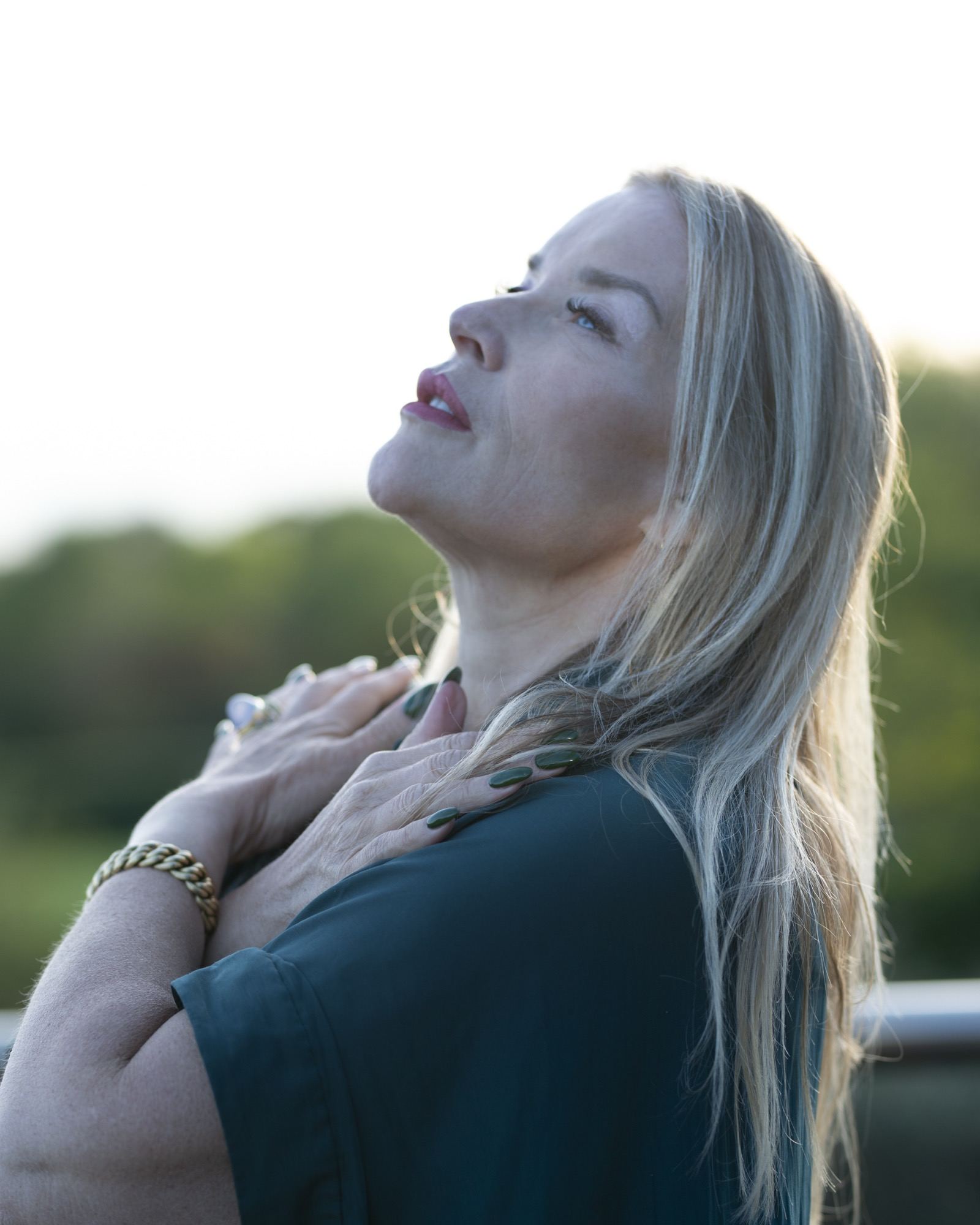
In conversation with Theresa Swan, a certified peristeam hydrotherapist, former trauma therapist, and the woman behind Luminous Creatrix. She works with women on pelvic health through personalised steaming plans, makes her own herbal blends, and sees clients internationally.
I am post-menopause, and I am having the best intimacy of my life. People find that genuinely startling, which tells you how little we say out loud about what happens to a woman's body after fifty and what is still completely available to her. So when Theresa came on to talk about tissue health, dryness, pain and pleasure, I was not being polite. I was taking notes.
She Went For a Massage Out of Curiosity
Theresa had a whole other career first, as a trauma therapist. Then she booked a massage that was supposed to centre around the womb, for no reason other than curiosity, and the practitioner asked whether she would like to try a yoni steam.
She said yes without knowing what it was. Afterwards she went home and thought, what just happened. Why did I have my yoni steamed.
So she went online, found an actual practitioner, had herbs sent to her, and steamed on her own living room floor in child's pose. Her cramps and her cysts went.
That result is what sent her to train. She now holds both certifications and is one of very few advanced practitioners worldwide at the level called certified peristeam hydrotherapist.
What Blew Her Mind Was Not the Physical Part
Theresa was trained in a very physical health direction. Cramps. Atrophy. Dryness. Fibroids.
What she did not expect, coming from years of trauma work, was what she started seeing after a steam session. Her words: you can palpably see the nervous system shift. She described it as a state change, and said it blew her away more than any of the trauma therapy practices had, which she finds ironic given where she came from.
She has a theory about why, and she is careful to call it a theory. Her sense is that the vagus nerve innervates the pelvis, and that steaming brings that online. Her own words on the mechanism: we do not know.
I liked that she said it that way. There is a lot of certainty for sale in this field and not much of it is earned.
Where This Meets My Own Work
I do internal work. I am a tantrika, I have worked in conscious sexuality for a long time, and I have been a dominatrix, which gave me a great deal of material about how bodies respond under intensity. What I do with people is help them reach ecstatic states, so that trauma can move through rather than stay stuck in the body.
Theresa and I both came at this through trauma, and we have both landed in the same question. Yes, and what can we add that makes this more pleasurable. Can those sensations feel less abrupt. Can the body get used to taking in a lot of sensation again.
Because here is the part that governs everything else.
"We cannot bring in pleasure if the body is braced."
A braced body is occupied. It is holding a position against something. Sensation arriving at a guard does not get through, however skilled or loving the hand delivering it. So before anyone needs a better technique, the body needs more room to receive.
That is why a practice whose main effect is deep relaxation is interesting to me, and not a side quest. It is working on the same variable from the other end.
The Thread We Lost
What I find remarkable is how old this is. Theresa says the practice has been found in seventy countries, on every continent on earth, in Europe, Asia, Africa, South America. Women have been doing it for hundreds and probably thousands of years, because it is about as complicated as making a cup of tea.
Western cultures dropped the thread.
I said out loud what I was thinking while she talked, which is that I cannot hear this history without thinking about the women who were burned. We were the medicine women. This was medicine, so that a woman would not have to be in that much pain.
Theresa agreed that the European part of this history is dark, that medicine women were stopped from practising, and that gynaecology itself has grim beginnings involving men cutting women open to work things out.
Her position now is integrative rather than oppositional, and I respect her for it. Get medicine from your doctor and steam. She wants doctors to know this exists and to refer, precisely because there are things they cannot help with. Her example: most women believe period cramps are simply part of being a woman, and there is no medical treatment offered for them.
What She Sees, In Her Own Words
These are Theresa's clinical observations from her own practice, not settled science, and she gives them as that.
- Cramps. Her explanation is mechanical. The uterus makes small contractions to expel old blood, clots and the endometrium. Add circulation with steam and the body can clear it, so it has less reason to contract.
- Dryness and atrophy. She describes bringing circulation and blood flow to thinning tissue, and seeing dryness and atrophy reverse. She cites research from Korean universities on this, where she says it has been studied.
- BV. She says roughly one in three women experience it at some point, that she has clients who have carried it for eight or ten years through round after round of antibiotics, and that with steaming she generally sees it gone inside two weeks.
- Scar tissue. One client had thirty years of painful sex after tearing in birth. Thirty. With a steam plan for scar tissue, Theresa says it was gone within three months and the woman was having pleasurable sex for the first time in three decades. Theresa got emotional telling it, and said the thing that stayed with me: if we knew, we would not have to suffer.
- Birth. She mentions dozens of hospitals in the Czech Republic now steaming for birth, and that where she steams for labour preparation she sees far less tearing than the figure usually quoted, along with less stalled labour. Postpartum healing is, she says, the most common use of steaming worldwide.
- Painful sex. Around half of her clients come with it.
Her two standing lines, which are the useful ones whatever you decide about steaming: periods are not supposed to be painful, and sex is never supposed to be painful.
Trust Your Body, Then Get a Real Practitioner
Theresa's advice is not do it yourself from a video. She said the opposite, repeatedly.
There are two levels of training. A peristeam facilitator, and a peristeam hydrotherapist. If something more complex is going on, prolapse, BV, fibroids, scar tissue, she says go to a hydrotherapist who can build a plan for your particular body.
The blends matter too, and she is blunt that selling one blend for everybody is misinformation. One example she gave: a cycle of twenty seven days or less points to a gentler blend, worked to strengthen the uterine artery and lengthen the cycle. Dryness and atrophy with excess heat point to a cooling blend that nourishes tissue.
She also took on two myths directly. That you will burn yourself, which she compares to a cup of tea, you do not drink it the second the water goes in, you let the herbs steep and it comes down to temperature. The second myth is that it is unsafe for your pH or around infections, where she says what she sees is the opposite.
If You Want to Try It, Here Is Her Setup
This is Theresa's practice, described as she described it, and it is hers rather than mine.
You do not need a sauna. You can do it on your knees in child's pose, which is how she started on her living room floor, though she is honest that ten minutes in child's pose has your inner thighs complaining by the end, and she would rather the body were properly relaxed.
Her workaround without buying anything: two chairs of the same height facing each other, a bum cheek on each, and the pot raised on books so the top of it sits about five inches from your body.
The method. Boil six cups of water. Add your herbs. Turn the heat off and keep the lid on. Let them steep for ten minutes. Then you are ready.
Most people are indicated for ten minutes. Some for thirty, depending on the body, and those are the people who need a hot plate, because over ten minutes the steam dissipates by itself.
Do not steam while you are bleeding. In her practice you do not steam through most of pregnancy either, and only from around week thirty eight or thirty nine, practitioner led.
Two Questions Before You Close This Page
I have twin daughters. One of them has periods so painful that I listened to this episode already knowing I was going to make her hear it.
So, two things.
What have you been quietly filing under this is just how my body is. The cramps you plan your month around. The dryness nobody asked you about. The sex that hurts and that you have stopped mentioning.
Then picture it a year from today, exactly as it is. Same month, same enduring, another twelve months of calling it normal because nobody told you there was a conversation to have.
The twelve months are the part I would mind.
Share this with the woman you thought of while you were reading. It may feel a bit cringe to say you listened to a podcast about this. There is a great deal of healing in it.
Listen to the full conversation
Season 2, Episode 44, From Pain to Pleasure, with Theresa Swan. Twenty four minutes.
Find Theresa. Instagram @luminouscreatrix · luminouscreatrix.shop · she offers a free fifteen minute is this for me video call, and she ships her herbal blends worldwide.
Everything about steaming, peristeam hydrotherapy, the herbal blends, the protocols and the clinical observations above is Theresa Swan's own work, training and practitioner experience, in her own words.
Work with Juliette: feelfullyyou.com/work-with-me
The experiences and health claims discussed in this episode reflect the guest's views and practitioner experience and are shared for educational purposes. Yoni and vaginal steaming is not a substitute for medical diagnosis or treatment. If something hurts, keeps returning, or worries you, please also see your doctor.