The science teacher lifted a tarantula in each hand and set one on each of my palms.
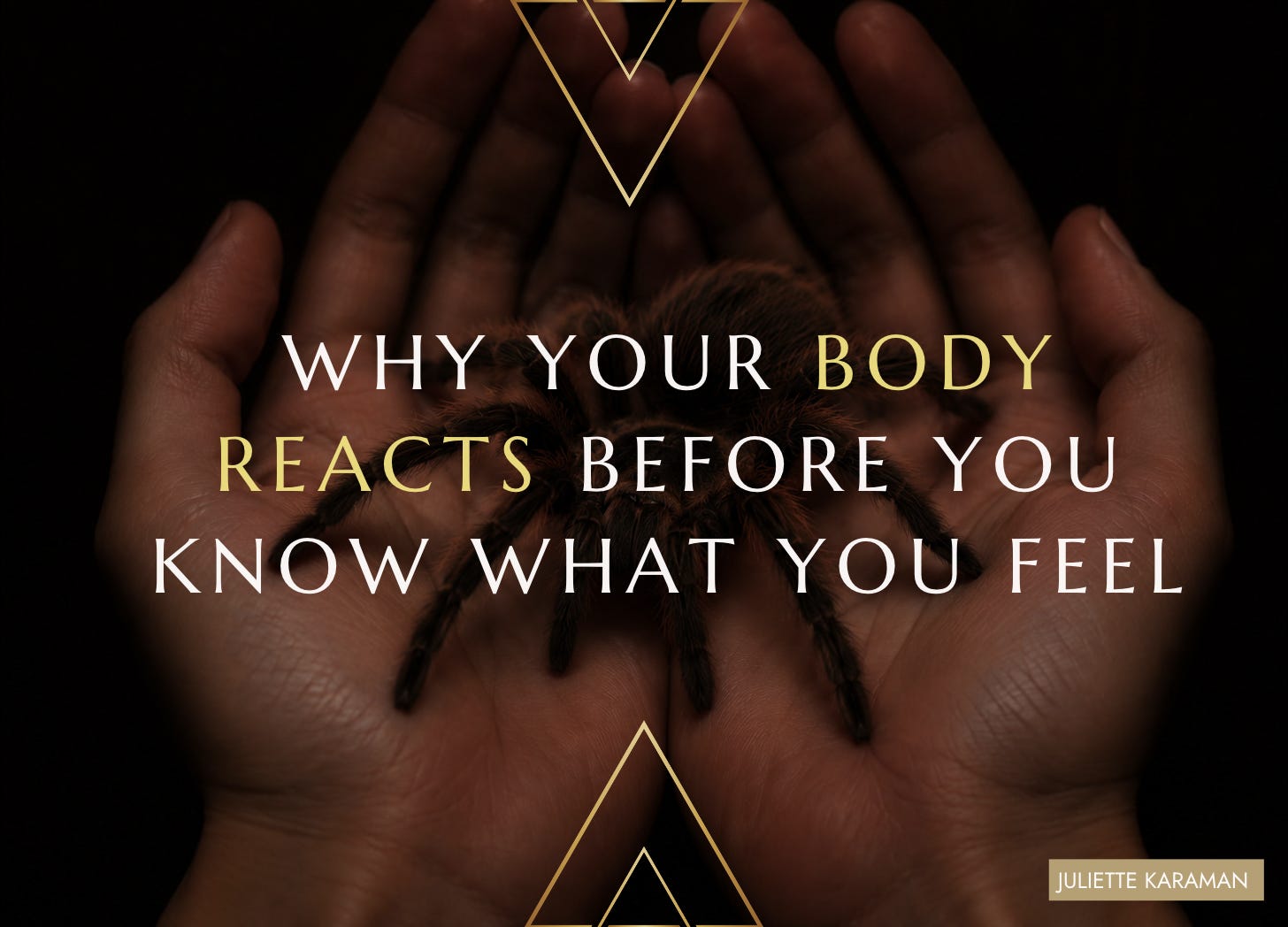
I was a teenager in Texas, a foreigner in that school anyway, still learning which rules everyone else seemed to have been born knowing. The classroom went quiet in the way a classroom does when everyone is watching someone else.
I could feel the weight of them.
Then four things happened, close enough together that I would have told you it was one thing.
I saw hairy legs.
My throat closed.
I was afraid.
Underneath all of it ran a sentence: I want to scream and I can’t.
I would have told you, if you had asked me that afternoon, that I had a fear of spiders. One fear. One lump of terrible.
It took me years to learn that I had been holding four separate things, and that the fear was only the loudest of them.
“Four things? It felt like one.”
It always does.
Every experience you have arrives in four parts. An image. A thought. An emotion. A body sensation.
The image is whatever your mind is showing you. Hairy legs. A face across a table. A closed bedroom door.
The thought is the sentence that runs underneath it. I want to scream and I can’t. I’m too much. He’s going to leave.
The emotion is the name you would give it if someone asked. Afraid. Ashamed. Furious.
The body sensation is the one almost everybody skips, and it is the one the other three are standing on. A closed throat. A fist under the ribs. Heat climbing the back of the neck.
Most of us live almost entirely in the emotion and the thought. We say I’m anxious and we say I can’t do this, and the image and the sensation are running the whole show from behind the curtain, unreported.
When the four are fused, the charge is enormous. It feels like a wall. It feels like who you are.
When the four are pulled apart and looked at one at a time, something different happens.
“That sounds like naming your feelings.”
It is related. It is also a good deal more specific.
There is solid research that putting a feeling into words quietens the amygdala, the part of the brain that sounds the alarm. Matthew Lieberman’s lab showed it in 2007 with brain imaging, and it has been replicated since.
Naming helps. It reaches one of the four.
What I do in a room goes further, because the body sensation is the part that holds the charge in place, and a word for the emotion does not reach it.
You cannot talk a closed throat open. You can find it, locate it exactly, and then stay with it until it moves.
I teach this as RRRR®: Rapid Release, Rewire, Restore. The first thing in it is the plainest. Take one experience. Split it into the four. Then go around them.
“Go around them how?”
Here is the spider, run properly.
Image: hairy legs.
I look at the image and nothing else, and I ask the other three to wait. Then I check the charge. I put a number on it, zero to ten, because the number gives the body something to report against.
Then the body sensation. Throat closed. I do not try to open it. I ask where exactly it is, how big, whether it has a temperature, whether it has an edge. That is the Felt Sense vocabulary, and it is a way of attending that most people have never been taught.
Then the emotion. Afraid. Only that, for a moment.
Then the thought. I want to scream and I can’t.
That is one round.
Then I go back to the image and run it again. A few more rounds. Each time I check the number.
The charge does not drain because I have decided it should. It drains because each part of the experience gets seen, one at a time, after years of being carried all together.
By the end the tarantula is still a tarantula. The hairy legs are still hairy. What has gone is the thing that made my throat close.
“Is that all it is?”
It is simple, and simple is a long way from easy. The first few rounds feel like nothing is happening, and that is the stage where most people quit.
I did not know it had a name when I started doing it. I was doing it to myself, in my own body, years before I had the word for it, because something in me kept refusing to let experiences stay fused.
I did it with heights. I jumped out of a plane with my brother. Later I went paragliding in the mountains, because I was not going to let that one stay a wall.
I did it with the memory that surfaced in my body years after it happened, the one I had no conscious access to for most of my marriage. A memory like that does not come as a story. It comes as an image with no context, a body sensation with no explanation, an emotion that arrives late and out of proportion, and a thought that was formed long before I had language to examine it.
Four parts. All of them fused. All of them loud.
I learned the training afterwards, in rooms with qualified teachers. I qualified in it properly. What the training gave me was the structure around something my body had already been trying to teach me.
“Does it work on anything?”
No, and I will not pretend it does.
Start small. A flash of irritation. A flinch you cannot account for. A moment from last week that keeps replaying. Practise on the small things until the method is familiar in your body. The big things should not be taken apart alone, and some of them should not be taken apart without a trained person in the room.
What I can say is what I have watched. A woman arrived carrying twenty years of sexual trauma and left a single session without it in her body. I have watched people who had spent years in therapy, years in courses, years reading about their own patterns, feel something shift in forty minutes, because for the first time someone asked them where it was in the body rather than why it was there.
Why is a story. Where is a place. A place can be reached.
What this has to do with touch
Everything I teach about touch sits on this.
When a hand lands on a waist and her body tightens, there is an image, a thought, an emotion and a sensation, fused, arriving in under a second. When a man reaches and then pulls back, the same four are running in him.
Neither of them can fix what they cannot separate.
Couples come to me describing a single wall. We just can’t. She shuts down. He gets defensive. Take the wall apart into its four parts, in each person, and it turns out there was never one wall. There were eight small things, and several of them were easy to move.
“What does it feel like when it moves?”
Quieter than people expect.
There is no cathartic crash. Usually there is a breath the person did not plan to take, the shoulders dropping an inch, and then a small, slightly surprised laugh.
What I watch for is the moment a person realises the sensation is only a sensation. A tightness in the chest, with edges, that has been standing in for the whole of the thing. That realisation is months of work in the body, arriving in a quiet room.
What changes next is how the rest of the week goes. The thing that used to hijack a Tuesday afternoon turns up as a sensation with an address, and a person who knows how to find the address.
Try it, on something small
Pick something mild. A three out of ten, no higher.
Write four lines. Image. Thought. Emotion. Body sensation.
Spend longest on the body sensation. Where is it. How big. What shape. Does it have a temperature. Stay there until it shifts, even a little.
Rate it again. Zero to ten.
Go around once more. Image, sensation, emotion, thought.
If the number drops, you have just felt what I do for a living. If it does not, or if something bigger arrives, stop, and do something kind for your body. That is information, and it is a reason to bring in a person.
I have worked with men terrified of flying, men who got through every flight on medication or alcohol. After two sessions they flew without either, and years later it was still holding.
What changed was never the aeroplane. The fear stopped being one thing.
That is the method.
You are four small things that have been carried together for so long that they felt like a verdict.
I am not shocked by any of it. That matters more than the modality.
Juliette
Still following the breadcrumbs.
Juliette