You both say touch. You mean two different things.
One of you reaches out and the other goes quiet. One of you wants to be held and the other reads it as a demand. You are both trying. The touch keeps landing wrong anyway.
Touch that lands is a language. Most couples have never been shown their own.
The five languages
Touch reaches you in five distinct languages. You have a home language your body trusts most, and you almost certainly have one you learned to live without so long ago you forgot it was food.
Emotional is being heard, all the way through. Erotic is desire and aliveness, wider than sex. Energetic is the charge before anyone has even touched you: a look, the space between two bodies. Physical is skin, weight, warmth, proximity. Spiritual is awe, meaning, the sense of being part of something larger. Each one can land, miss, or starve, and your partner is almost certainly fluent in a different one than you are.
It's actually a stack, not one layer
The Touch Languages™ takes its name from the five languages, and it is more than them. Three things shape what happens every time anyone reaches for you, and only one of them changes by the hour.
Your Touch State is where your body is right now: Braced, Withheld, Performing, Present, or Melted. It changes hour to hour, and it decides whether anything can land at all. Your Touch Pattern is how you learned to guard, early, to stay safe and stay loved: The Holder, The Operator, The Wanderer. Your partner kisses the back of your neck. Your state answers first, whether a braced body files it under interruption or a present body lets it arrive. Your language answers next, whether that kiss is food or noise. Your pattern has the final word, whether you receive it, brace against it, or start planning what to give back. Same kiss, five seconds, three things deciding what happens next.
The Touch Reset: the method that puts it to work
Naming the stack is not enough on its own, which is why I built The Touch Reset, my four-part method for rebuilding touch when spontaneity has stopped working. Four rooms, always in this order:
You meet your wiring first, through the languages, patterns, and a free quiz. Structured communication, the Dyad, one prompt and three responses, rebuilds emotional safety before any touch is asked to carry weight. Structured touch dates, time-contained and non-sexual, are where the brace itself starts to soften. Structured touch rituals, small and daily, keep the nervous system fed between the bigger containers. Intimacy doesn't come back through spontaneity. It comes back through structure.
The Stages of Touch: which room you need first
Not every couple needs to start in the same room, and applying the wrong one is what makes people give up on each other, not insufficient love. I see three stages. The Quiet, where touch is still happening but something has gone flat, usually a language mismatch the map alone can solve. The Brace, where the body has started tightening before either of you decides it, a half-second ahead of the mind, needing communication before another touch date. The Gone, where the distance has started to feel like the relationship itself, recoverable, but needing all four rooms in order, usually with support.
Its own thing
The Touch Languages™ stands apart from the Intimacy and Communication Cards. It is my own registered framework, built from decades of working with bodies that had stopped letting touch in. The Cards open the conversations. The Touch Languages™ maps the touch itself: how your specific body wants to be approached, what opens it, what shuts it down, and how to ask for the difference.
When you know the language, the reaching finds you.
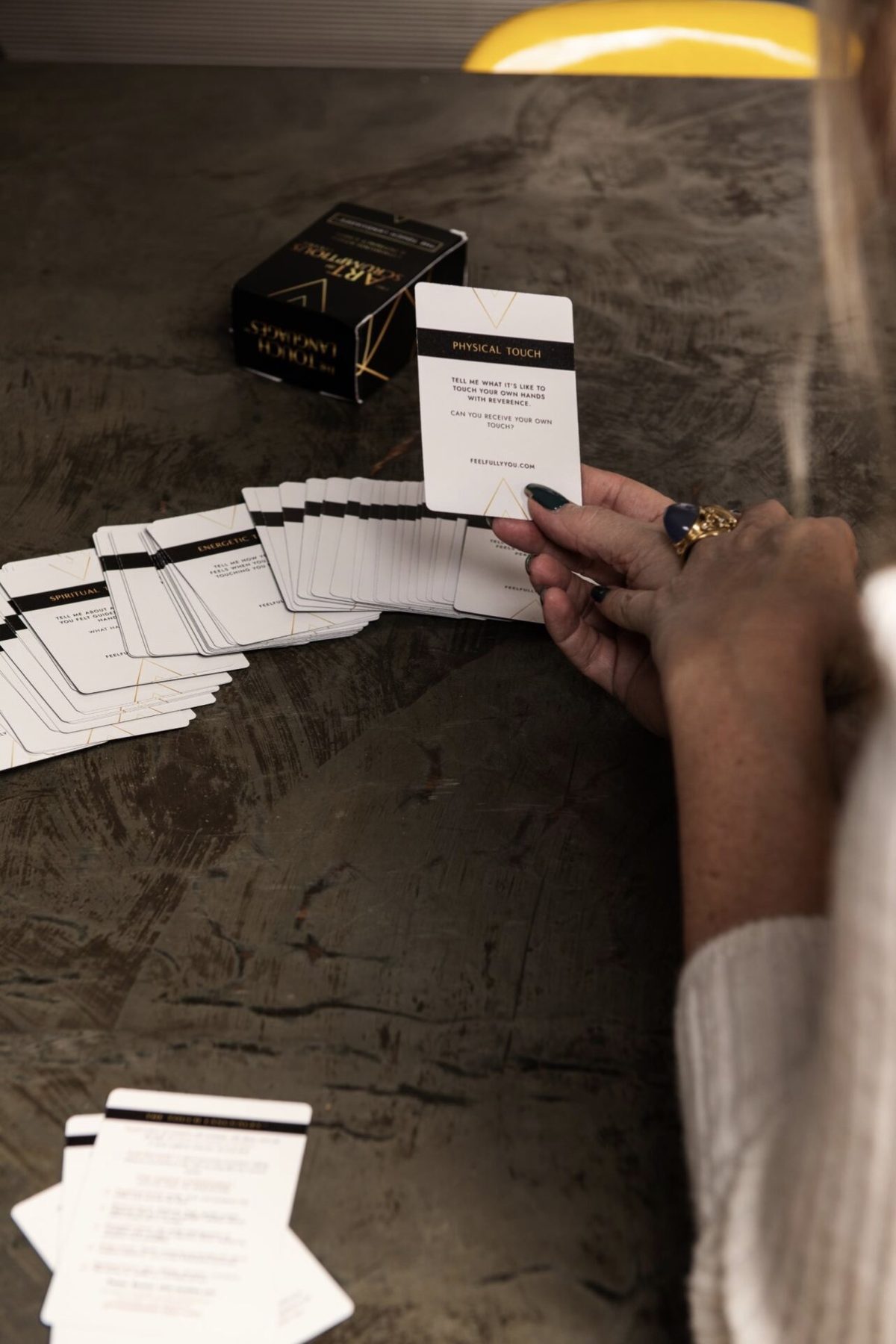
This is the framework I use with private clients, now in a deck you can open tonight at your own kitchen table.